Kitchen Kit
The short list of kitchen equipment that earns its space
Most kitchen shops sell solutions to problems home cooks do not have. A working kitchen needs surprisingly little.
Comparisons of kitchen equipment usually pick a winner. This one picks the circumstances, which is more useful.
The difference in one place
- One good chef's knife replaces most of a knife block.
- Heavy pans hold heat, which is the property that matters.
- Scales and a thermometer remove more guesswork than any gadget.
One knife does almost everything
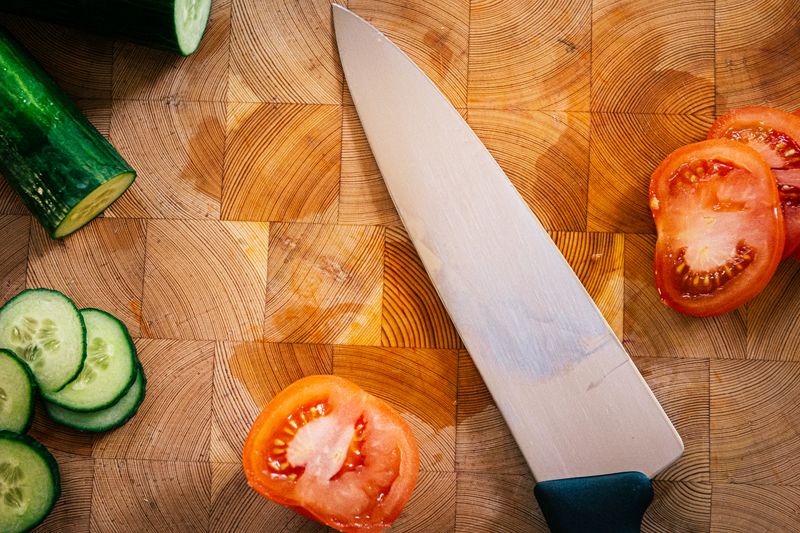
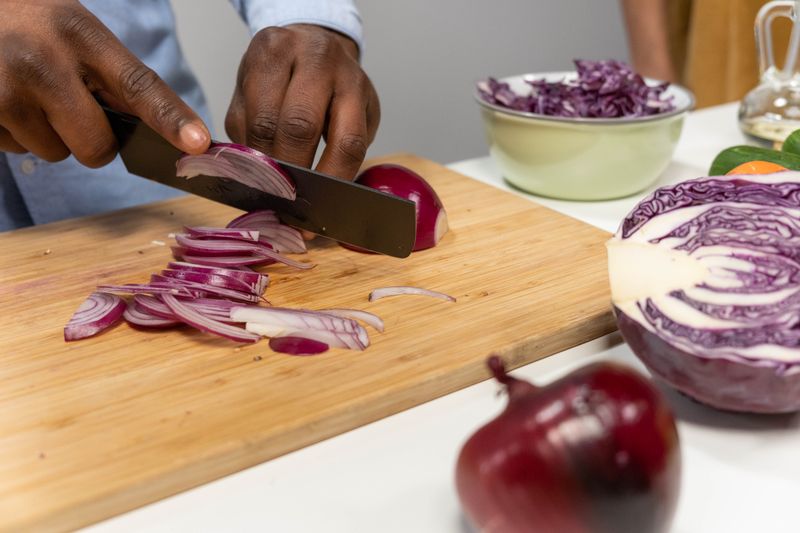
A single well-made chef's knife of around twenty centimetres handles the overwhelming majority of domestic cutting. A small paring knife and a serrated bread knife complete the set for practically any home cook. Knife blocks are sold as sets because sets sell, not because the additional knives get used.
Sharpness matters more than price: a cheap sharp knife outperforms an expensive blunt one and is considerably safer.
Pans are bought for thermal mass
The property that separates a good pan from a poor one is its ability to hold temperature when cold food is added. Cast iron and heavy stainless with a thick base do this; thin pans do not, whatever they cost. One heavy frying pan, one wide sauté pan with a lid and one large pot cover almost everything.
On a weeknight, there is an upper limit set by your wrists and your hob, since a pan too heavy to lift one-handed quietly stops being used and an oversized base on a small ring only ever gets hot in the middle.
Non-stick is a consumable
Non-stick coatings degrade with heat and abrasion and have a working life of a few years at best. That makes an expensive non-stick pan poor value and a cheap one entirely reasonable.
If you are short of time, keeping one for eggs and using something else for searing extends its life considerably. What destroys a coating fastest is being heated empty, which is also the condition manufacturers explicitly warn about, so it is the wrong pan to leave preheating hard while you go and find the eggs.
Measurement beats gadgets
Digital scales and an instant-read thermometer remove more uncertainty than any appliance. The thermometer in particular converts cooking meat from a source of anxiety into a checkable fact. Together they cost less than most single-purpose devices and get used far more often.
Scales also let you weigh straight into the bowl already sitting on them, which removes most of the washing up that puts people off baking in the first place.
Where to spend and where not to
Pans, knives and boards are the things your hands are on every day, and that is where money spent shows up in the cooking. Cast iron, heavy stainless and wooden boards last for decades, which makes them one of the few categories where buying second-hand costs a fraction and loses almost nothing. Anything with a motor, a coating or a battery has a working life instead, so paying twice for a longer one only makes sense if it comes out weekly.
The genuinely poor value is the specialist tool bought for a dish you have not yet cooked once, because that is a purchase made against an intention rather than a habit.
Adjust seasoning at the end rather than trusting a quantity written by a stranger.
What genuinely earns its space
A large chopping board, because small boards make everything harder and slower. A food processor if you cook a lot, a stand mixer only if you bake regularly, and almost nothing else with a motor. The test for any purchase is whether it will be used weekly; monthly use rarely justifies the cupboard.
The exception is anything that removes a real barrier — a pressure cooker for dried pulses, a stick blender for soups — since those change what you are willing to cook rather than how quickly you cook it.
Side by side
| Consideration | What it means in practice |
|---|---|
| One knife does almost everything | One good chef's knife replaces most of a knife block. |
| Pans are bought for thermal mass | Heavy pans hold heat, which is the property that matters. |
| Non-stick is a consumable | Scales and a thermometer remove more guesswork than any gadget. |
The takeaway
One sharp knife, one heavy pan, scales and a thermometer. The rest is optional.
The good version is the one you can make on a Wednesday.
Questions readers ask
How often should I sharpen a knife?
Hone with a steel frequently and sharpen properly a few times a year for normal home use. A knife that crushes a tomato rather than slicing it is overdue.
Is carbon steel worth it over stainless?
It heats and browns superbly and requires seasoning and drying. If you will maintain it, it is excellent; if not, stainless or cast iron is the better choice.
Also by Piotr Wesely
- The tray bake is the most underrated weeknight methodWeeknight Dinners
- Fifteen minutes is a shopping decision, not a cooking speedWeeknight Dinners
- Mise en place is not fussiness, it is the reason nothing burnsWeeknight Dinners
- Eggs are the fastest protein in the kitchen and the least respectedWeeknight Dinners