Kitchen Kit
Knife skills are about the board, the grip and the speed you are not using
Fast chopping is a consequence of good technique, never a route to it. The fundamentals take an afternoon.
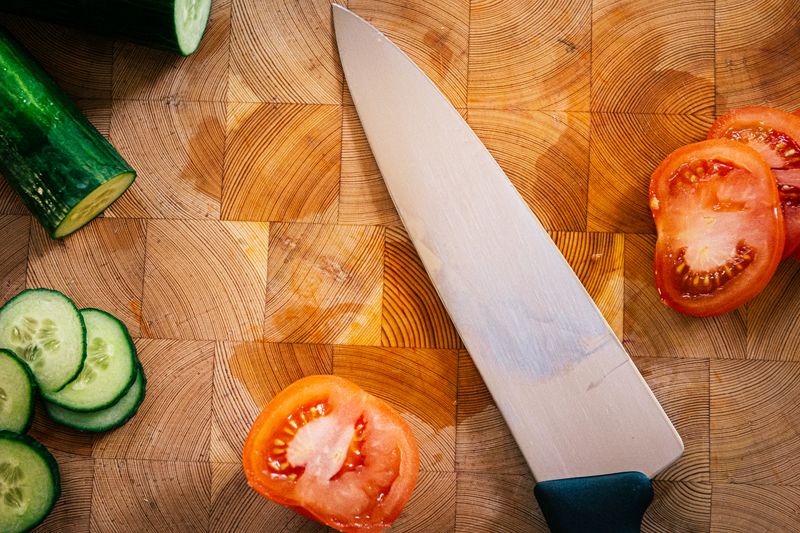
These are listed in the order worth acting on, which with knife skills is not the order they are usually presented in.
What matters most
- A pinch grip on the blade gives control that a handle grip does not.
- The guiding hand curls its fingertips back behind the knuckles.
- A stable board is a safety measure, not a convenience.
Grip the blade, not the handle
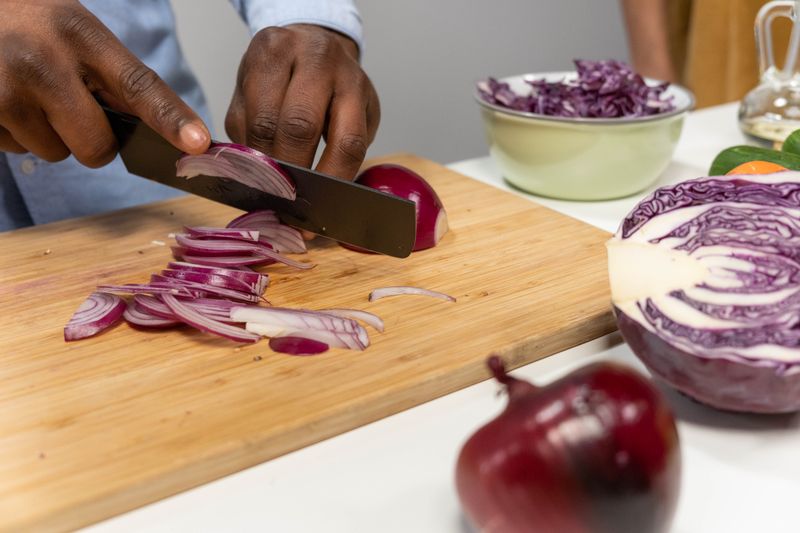
The pinch grip — thumb and forefinger on the blade just in front of the handle — puts your hand at the balance point and gives far more control. Gripping the handle alone means steering the knife from behind, which is imprecise and tiring. It feels wrong for about ten minutes and then feels obviously correct.
Nearly every visible difference between a trained and untrained cook chopping comes down to this one thing.
The other hand is the guide
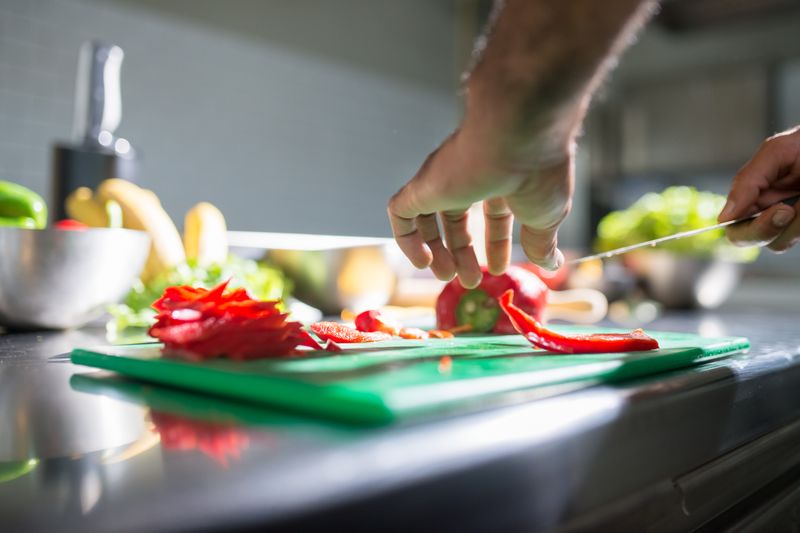
Curling the fingertips under so the knuckles face the blade lets the flat of the knife rest against them as a guide. The blade then cannot reach the fingertips, and the knuckles set the thickness of each slice. This is the claw grip, and it is a safety mechanism and a precision mechanism at the same time.
At the stove, that hand also does the moving, feeding the food forward a slice at a time while the knife stays on one spot, which is what makes the pieces come out the same size.
Let the knife do the work
A sharp knife cuts on a forward or backward slicing motion rather than by pressing straight down. Pressing down crushes and requires force, which is where slips happen. The tip generally stays in contact with the board while the heel rises, producing a rocking motion that is efficient and controlled.
Hard vegetables such as squash are the exception, where a straight push with the heel and the other hand flat on the spine is safer than trying to slice through something the blade cannot get into.
Stabilise everything
A damp cloth under the board stops it moving, which removes the most common cause of accidents. Round vegetables should be cut flat on one side first so they cannot roll — this single step prevents a large share of kitchen injuries. A board large enough to hold what you are cutting means you are not working in a crowded space.
If you are short of time, letting the board sit a little proud of the counter edge gives your knuckles somewhere to go, which stops you working all evening with the wrist bent upward.
Care is what keeps the edge
Dishwashers blunt and corrode knives through heat, detergent and knocking against everything else in the basket, which is why almost every maker asks for hand washing and immediate drying. Cutting on glass, stone or ceramic ruins an edge within a few strokes, and those surfaces are sold as boards precisely because they look clean.
At the stove, honing with a steel straightens an edge that has rolled over rather than removing metal, which is why it works between sharpenings and is not a substitute for one. Stored loose in a drawer, a blade chips against everything in there; a magnetic strip, a block or a plastic guard costs very little and prevents it.
Ovens, pans and produce vary — trust what you can see and hear over any timing.
Speed is an output
Chopping quickly is what happens after the movement becomes consistent, and trying to be fast first produces uneven cuts and injuries. Even cuts matter because they cook evenly, which is the actual culinary reason to care about any of this.
Practising on a bag of cheap onions for twenty minutes does more than watching any amount of video. What breaks the movement first is a work surface at the wrong height, since a counter that forces your shoulder up changes the angle of the blade and the evenness goes with it.
Everything above, in order of what to do first
- Grip the blade, not the handle. The pinch grip — thumb and forefinger on the blade just in front of the handle — puts your hand at the balance point and gives far more control.
- The other hand is the guide. Curling the fingertips under so the knuckles face the blade lets the flat of the knife rest against them as a guide.
- Let the knife do the work. A sharp knife cuts on a forward or backward slicing motion rather than by pressing straight down.
- Stabilise everything. A damp cloth under the board stops it moving, which removes the most common cause of accidents.
- Care is what keeps the edge. Dishwashers blunt and corrode knives through heat, detergent and knocking against everything else in the basket, which is why almost every maker asks for hand washing and immediate drying.
- Speed is an output. Chopping quickly is what happens after the movement becomes consistent, and trying to be fast first produces uneven cuts and injuries.
The takeaway
Pinch the blade, curl the fingers, wet cloth under the board. Speed arrives on its own.
Get the heat and the salt right and the rest is detail.
Questions readers ask
Is a sharp knife really safer?
Yes. A blunt knife requires force and slips off surfaces rather than biting into them, which is how most kitchen cuts happen.
Wooden or plastic board?
Both are fine with proper cleaning. Wood is kinder to knife edges; plastic goes in the dishwasher. Keep a separate board for raw meat either way.
Also by Orla Bannon
- A good sear is a dry surface and a hot pan, and nothing elseTechnique
- Ten meals is a repertoire, and it is enoughWeeknight Dinners
- Dried pulses against tins: what you actually gain by soakingPantry & Shopping
- The freezer is a pantry and most people use a third of itPantry & Shopping