Kitchen Kit
The chopping board matters more than the knife on it
A board that slides, dulls edges or is too small does more damage to your cooking than any knife you could buy.
Everything below about chopping boards comes from what actually happens rather than from what is supposed to.
What holds up in practice
- Glass and stone boards ruin knife edges immediately.
- Board size determines how fast and safely you can work.
- Both wood and plastic can be used hygienically with proper cleaning.
Hardness decides what happens to the edge
A board harder than the knife blunts it on every stroke, which is what glass, granite and ceramic boards do. Wood and plastic are softer than the steel and allow the edge to bite in rather than skid or roll.
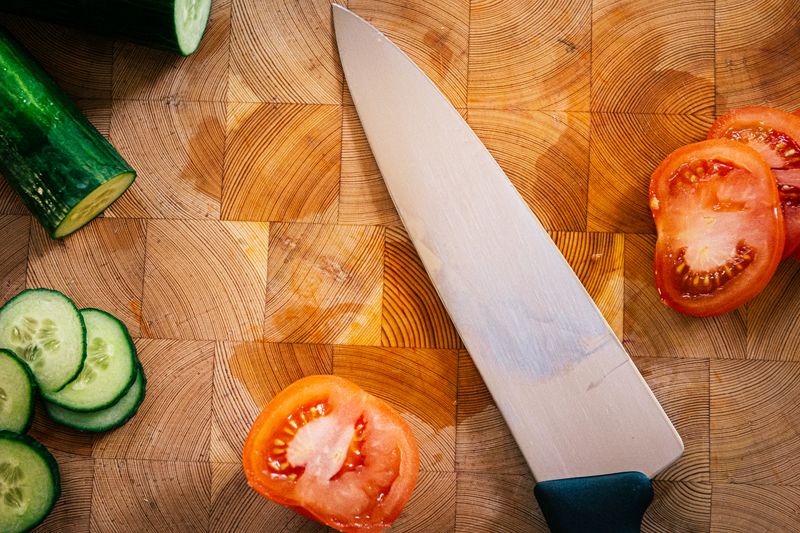
End-grain wooden boards let the fibres part and close around the blade, which is why they are gentlest of all. No sharpening routine compensates for a board that is destroying the edge as fast as you restore it.
Size is a working constraint
A board too small forces you to work in a crowded space and to stop and clear it repeatedly. The chopped pieces need somewhere to go, and pushing them to the far edge is what a large board allows.
A board that overhangs the worktop slightly makes it easier to sweep waste into a bowl. Most home boards are smaller than they should be, which slows every prep task without anyone noticing.
Stability is a safety issue
A board that slides while you cut is the most common cause of kitchen accidents that are entirely preventable. A damp cloth or a wet paper towel underneath stops it completely and takes two seconds.
Nine times out of ten, some boards have rubber feet, which work until the feet fall off, which they eventually do. Uneven worktops and boards that have warped both cause rocking, which is worth checking for.
The hygiene argument
Research on wood and plastic has gone back and forth for decades, and the consensus is that both are safe when cleaned properly. Deep knife scores in plastic harbour bacteria and are difficult to clean, which is why heavily scored boards should be replaced. Wood can go through many years of use, though it should not be soaked or put in a dishwasher.
Your national food safety guidance covers board use for raw meat, and separating boards by use is the practical takeaway.
Caring for wood
Wooden boards need washing and drying rather than soaking, and standing them on edge lets both faces dry evenly. Periodic oiling with a food-safe mineral oil keeps them from drying and cracking. Cracks and splits are where a board becomes hard to clean and is the point at which it should be retired.
Bamboo is technically a grass, harder than most hardwoods, and harsher on edges than people expect.
A workable arrangement
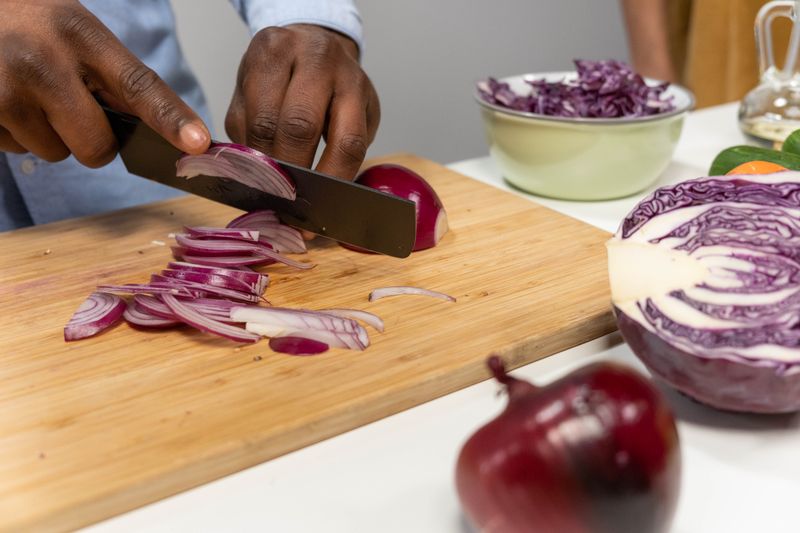
One large board for general prep, one smaller board for raw meat and fish, and something you do not mind staining for beetroot and turmeric. Colour-coded plastic boards are a professional convention that works perfectly well at home.
Keeping a board out on the worktop rather than stored away removes a barrier to cooking at all. A bowl for trimmings beside the board is the accessory that speeds up prep more than any gadget.
The takeaway
Big board, soft material, damp cloth underneath, and a separate one for raw meat.
Get the heat and the salt right and the rest is detail.
Questions readers ask
Wood or plastic for raw meat?
Either is acceptable with proper cleaning. Plastic goes in the dishwasher, which many people find reassuring. The important part is not using the same board for ready-to-eat food without washing it.
When should I replace a board?
When it is deeply scored, cracked or warped enough to rock. At that point it is hard to clean and hard to work on safely.