Kitchen Kit
Wooden, Silicone And Metal Utensils Each Fail Differently
Utensil material determines heat tolerance, surface damage and how much residue is absorbed, which is why one drawer usually needs all three types.

Utensils are chosen by shape and inherited by accident. Material matters more, because each one has a specific failure mode that shows up in a particular job.
Wood is gentle and porous
Wooden spoons do not scratch coatings, do not conduct heat to the hand and are stiff enough to scrape a pan base without flexing.
They are also porous, absorbing fat and pigment over time, which is why an old spoon smells faintly of everything it has been used for.
Soaking them is the main cause of damage, since water swells the fibres and the surface cracks as it dries, creating places for residue to lodge.
Silicone tolerates heat but flexes
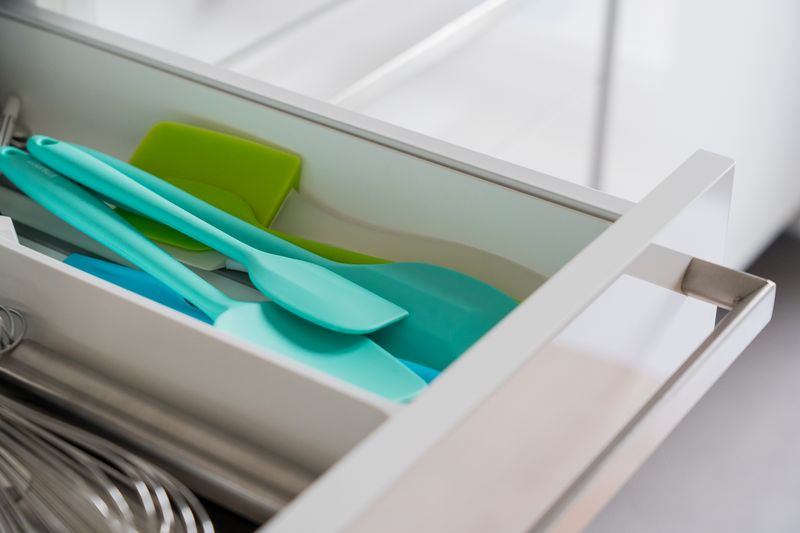
Silicone withstands high temperatures, does not stain easily and is non-porous, which makes it the easiest of the three to clean thoroughly.
Its flexibility is the advantage for scraping bowls and folding batter and the drawback for anything requiring pressure against a pan.
Quality varies considerably. Cheaper silicone can be a thin coating over a metal or plastic core, and it splits at the join once heated repeatedly.
Metal is rigid and unforgiving
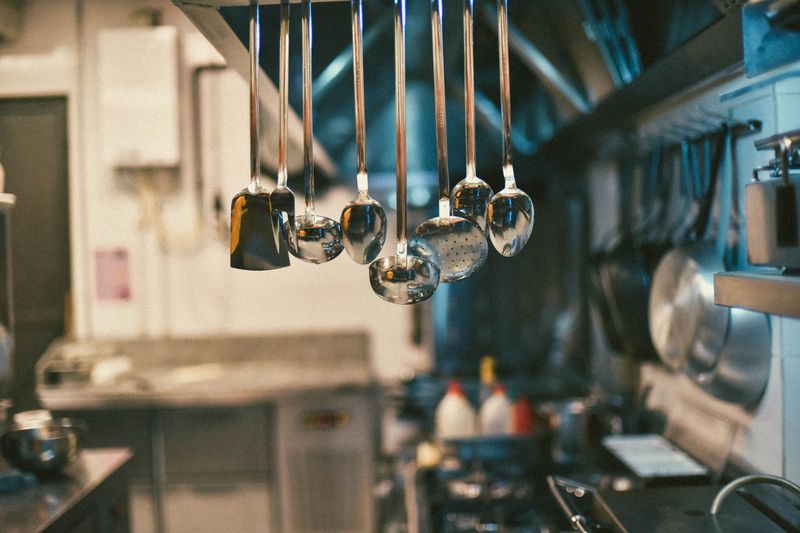
Metal utensils are the only ones stiff enough for lifting heavy items, turning something whole, and getting under food that has stuck.
They conduct heat, so a spoon left in a pot becomes dangerous to grip, and they scratch non-stick coatings immediately and permanently.
On stainless, cast iron and carbon steel none of that matters, which is why metal utensils and metal pans tend to arrive in a kitchen together.
Matching the utensil to the pan
Non-stick pans are the constraint that shapes the whole drawer, since one absent-minded use of a metal spatula ends the coating's useful life.
Households with both coated and uncoated pans generally end up storing utensils in two places, which is a more reliable rule than remembering.
Nylon utensils occupy a middle ground and are safe on coatings, though they soften and deform at high temperatures more readily than silicone.
Shape still matters after material
A flat edge reaches the corner where the base meets the wall of a pan, which is where food catches and where a rounded spoon never touches.
A thin front edge slides under food without tearing it, which is why a fish slice and a general turner are not interchangeable.
A slot or perforation lets liquid drain rather than carrying it, and that difference decides whether a sauce is left in the pan or on the plate.
Questions readers ask
Do I need to use the guard?
Yes, every time. The injuries happen at the end of the vegetable when the hand is closest to the blade, and by then it is too late to start.
Is a mandoline worth buying?
If you regularly slice large quantities or need genuinely thin even slices, yes. For a few slices at a time a knife is faster once you count setup and cleaning.
Also by Piotr Wesely
- The tray bake is the most underrated weeknight methodWeeknight Dinners
- The short list of kitchen equipment that earns its spaceKitchen Kit
- Fifteen minutes is a shopping decision, not a cooking speedWeeknight Dinners
- Mise en place is not fussiness, it is the reason nothing burnsWeeknight Dinners