Technique
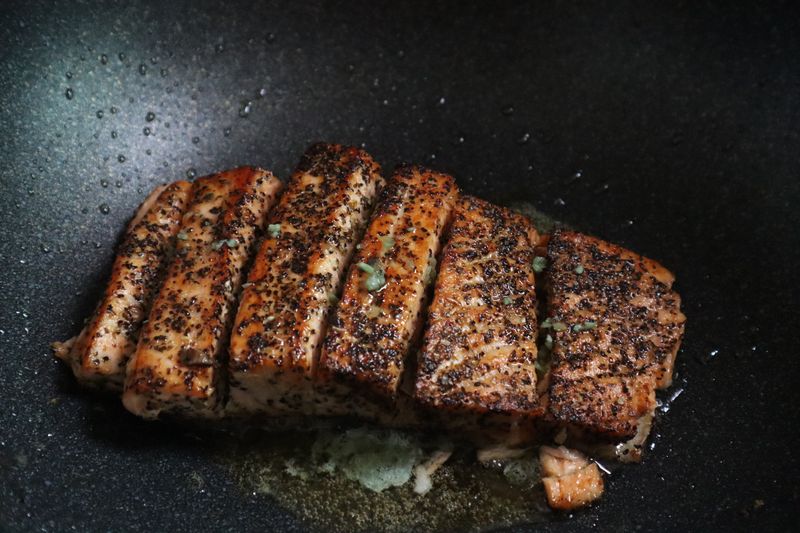
A good sear is a dry surface and a hot pan, and nothing else
Browning is a chemical reaction with a temperature requirement. Everything that goes wrong is a failure to reach it.
The theory of searing is well covered elsewhere. This is about the version you meet in practice.
What holds up in practice
- Surface moisture must evaporate before browning can begin.
- Crowding the pan drops the temperature and steams the food.
- Searing does not seal in juices — that idea was disproved long ago.
Water is the enemy of browning
The Maillard reaction that produces browning needs a surface temperature well above the boiling point of water. While the surface is wet, all the energy goes into evaporating that water and the temperature cannot rise.
Patting food thoroughly dry before it meets the pan is therefore not fussiness; it is the whole technique. Salting and resting uncovered in the fridge dries the surface further and produces a visibly better crust.
Crowding is the usual failure
Adding too much food at once drops the pan temperature below the browning threshold and releases moisture faster than it can evaporate. The result is grey, steamed food in a pool of liquid, which no amount of extra time corrects. Cooking in batches takes longer and is the difference between the dish working and not.
The part that matters: the tell arrives within seconds: a loud sizzle that fades to near silence means the pan has lost the argument, and lifting half the food back out at that point still rescues it.
The pan matters more than the heat setting
Thermal mass is what maintains temperature when cold food arrives, which is why heavy cast iron and carbon steel outperform thin pans. A thin pan on maximum heat still crashes in temperature the moment food touches it.
The part that matters: preheating properly — until the pan is genuinely hot, not until the hob has been on for a while — is the other half. Induction, gas and electric plates recover heat at very different rates, so the same pan behaves differently on each and the setting a recipe names is worth less than knowing your own hob.
Sealing in juices is a myth
The idea that searing seals meat has been tested repeatedly and does not hold; seared meat loses at least as much moisture as unseared. What searing does is create flavour compounds and texture, which is a far better reason to do it. Resting after cooking does more for perceived juiciness than any searing technique.
The reverse sear follows from the same physics: bringing the meat up gently first and browning it at the very end gives an even interior and a crust, which doing both at once cannot.
A real sear makes smoke, and that is manageable
A pan hot enough to brown will smoke from whatever fat is on it, which is precisely why home cooks turn the heat down at the critical moment and end up with grey food. Extraction on before the pan goes on, a window open, and a thought spared for where the smoke alarm is, are what let you leave the heat where it needs to be.
Oiling the food rather than the pan produces noticeably less smoke, because there is no free oil sitting on bare hot metal. Anything already burnt on — stray flour, loose garlic, blackened fat from the last batch — should come out before the next one, since it only smokes harder and turns bitter.
Deglazing is the point of the brown bits
The fond stuck to the pan is concentrated flavour and is the basis of most quick pan sauces. Adding liquid while the pan is hot lifts it in seconds, and this is where a great deal of restaurant flavour comes from. A non-stick pan produces very little fond, which is a genuine reason to use something else when a sauce is intended.
In practice, fond burns about as easily as it forms, so the moment to add liquid is when the pan is deep brown rather than black, and something acidic lifts it faster than plain water does.
The takeaway
Dry surface, hot heavy pan, and fewer things in it than you want.
Taste it before it leaves the pan. That is most of cooking.
Questions readers ask
Should I use oil or butter?
Oil for the sear because it tolerates higher temperature, then butter toward the end for flavour and browning. Butter alone burns before a good crust forms.
How do I know the pan is hot enough?
A drop of water should skitter across the surface rather than sizzle in place. For oil, it should shimmer and move freely.
Also by Orla Bannon
- Ten meals is a repertoire, and it is enoughWeeknight Dinners
- Knife skills are about the board, the grip and the speed you are not usingKitchen Kit
- Dried pulses against tins: what you actually gain by soakingPantry & Shopping
- The freezer is a pantry and most people use a third of itPantry & Shopping