Technique
Carryover cooking means taking it off before it is done
Food does not stop cooking when it leaves the heat. Ignoring that is why so much carefully timed cooking arrives overdone.
The theory of carryover cooking is well covered elsewhere. This is about the version you meet in practice.
What holds up in practice
- Stored heat in the outer layers keeps flowing inward after cooking stops.
- Larger pieces and hotter methods produce more carryover.
- The only reliable way to see it is with a thermometer.
Heat already in the food
When you remove food from an oven or a pan, the outer layers are holding a large amount of energy that has nowhere to go except inward. The centre therefore keeps rising in temperature for some time, sometimes long enough to move meat a full stage of doneness. This is why an accurately timed roast can still emerge overcooked at the table.
It is not a mysterious effect; it is simply conduction continuing after the heat source is removed.
What makes it bigger
Mass matters most: a large joint holds far more stored heat than a thin steak and will climb far more. A steep temperature gradient increases it, which is why a very hot oven produces more carryover than a low one.
Dense foods with high water content carry more than airy ones, so a potato climbs and a bread roll does not. Resting on a hot tray adds to it, and moving to a cool plate reduces it.
Plan the finish backwards
Decide the temperature you want at the table, then subtract an allowance and remove the food at that lower reading. The allowance is small for thin cuts and substantial for large roasts, and it is worth noting what happened so the next one is better. A thermometer left in during the rest shows the climb and then the plateau, which is the moment to carve.
At the stove, guessing this repeatedly without measuring is why the same recipe gives different results each time.
It applies well beyond meat
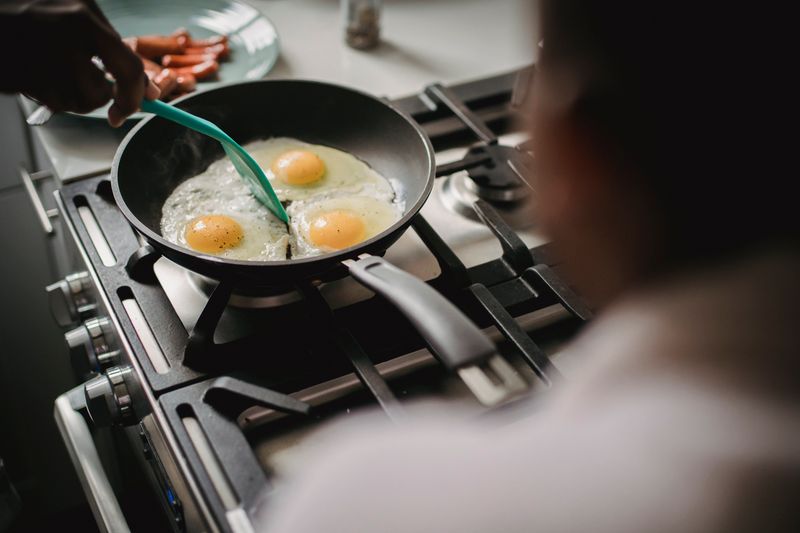
Eggs continue to set off the heat, which is why scrambled eggs should leave the pan looking slightly loose. Custards and sauces thicken further as they cool, so a sauce that looks right on the hob is usually too thick on the plate. Vegetables keep softening, which is the reason for plunging blanched greens into cold water.
Baked goods continue to set as they cool, which is why cutting a cake or a loaf too early gives a gummy texture.
Stopping it deliberately
Cold water, an ice bath or spreading food in a thin layer are the ways to halt carryover quickly. This matters for anything you want to keep a precise texture, from green beans to soft-boiled eggs. It also matters for food safety, since cooling quickly through the warm range limits bacterial growth.
Your national food safety guidance sets out the cooling advice for your country, and it is worth reading once rather than guessing.
Working with it rather than around it
A low-temperature cook followed by a fast sear at the end gives a shallow gradient and very little carryover, which is why it hits targets accurately. Cooking a large piece at a lower oven temperature narrows the gradient and makes the finish more forgiving. Conversely, a blistering-hot method gives a great crust and demands you pull the food early.
Nine times out of ten, neither is better; they simply require different arithmetic at the end.
The takeaway
Take it off early, measure the climb once, and remember what you learned for next time.
Taste it before it leaves the pan. That is most of cooking.
Questions readers ask
How much will a roast climb?
It depends on size, oven temperature and where you rest it, so measure rather than trust a number. Larger and hotter means more, and a thermometer left in shows the peak.
Does resting cause the extra cooking?
No, it reveals it. The heat was already in the food; the rest is simply the period during which it redistributes.
Also by Naledi Mothibi
- Salt at every stage beats salt at the endTechnique
- One-pot dinners work when the liquid is doing a jobWeeknight Dinners
- Home stir frying fails because the pan gets coldWeeknight Dinners
- Heat transfer explains most of the instructions in a recipeTechnique