Technique
Smoke point is a property of refining, not of price
Which oil to cook with is usually explained badly. What matters is how the oil was processed, what is left in it, and how hot you are actually cooking.
Everything here earned its place by changing an outcome. Nothing about cooking oils and heat is included to round the number up.
What matters most
- Refining removes impurities that break down first, which raises the smoke point.
- The same type of oil can have very different smoke points depending on processing.
- Most home cooking happens well below the point where the choice of oil is critical.
What the smoke point actually measures
Smoke point is the temperature at which an oil begins to break down visibly and give off acrid smoke. What breaks down first is not usually the fat itself but the free fatty acids and the small particles left in it after processing.
That is why the same botanical oil can have a low smoke point in an unrefined form and a much higher one when refined. A single figure printed for a category of oil is therefore an approximation that hides a wide range within that category. The practical version is that the more an oil has been processed and filtered, the more heat it tolerates before smoking.
Refined and unrefined do different jobs
Unrefined oils keep the aromatic compounds from the seed or the fruit, which is exactly what makes them worth eating. Those same compounds are what degrade under high heat, taking the flavour with them and leaving an unpleasant edge.
If you are short of time, refined oils have had most of that removed, so they are neutral in flavour and stable at higher temperatures. Keeping one of each is the sensible arrangement, with the neutral one for heat and the flavourful one for finishing. Using an expensive unrefined oil for hard frying wastes both the money and the quality that made it expensive.
How hot are you really cooking
A moderate pan for sauteing sits well below the smoke point of almost every common cooking oil. Hard searing and deep frying are where the difference becomes real, and those are a minority of home cooking sessions.
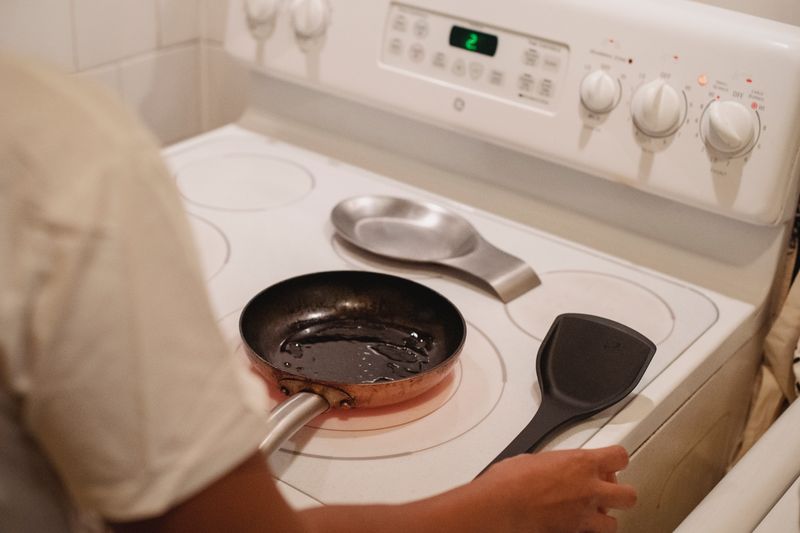
In practice, an oil that shimmers is hot and an oil that smokes has already passed the point you wanted, which is a usable visual test. A pan left empty on high heat overshoots very quickly, which is why oil is usually added to a warm pan rather than a cold one. Once oil has smoked significantly it is best discarded rather than cooked with, because the breakdown products taste bad.
The advice about olive oil
Repeated advice not to cook with olive oil comes from its comparatively low smoke point in unrefined form. In practice ordinary sauteing and roasting temperatures sit below that threshold, and it is used for exactly that across the Mediterranean. The strongest and most expensive versions do lose their distinctive character under heat, which is a flavour argument rather than a safety one.
Refined or lighter olive oils exist precisely for cooking and behave much like other refined oils. Evidence about what happens to different oils under prolonged heat continues to be debated, so it is worth avoiding confident claims in either direction.
Fat as a cooking medium
Butter contains milk solids and water, which is why it browns and then burns at a much lower temperature than pure fat. Clarified butter has had those solids removed, which is exactly the same principle as refining an oil. Mixing butter with oil is a common workaround, though the butter solids still brown at their own temperature regardless of what surrounds them.
Nine times out of ten, animal fats vary widely and many are stable at reasonably high heat, which is why they were the traditional frying medium in many places. The right choice depends on the flavour you want as much as the heat, and the two considerations often point in different directions.
If you are cooking for allergies, check every label rather than any recipe.
Storing oil so it stays good
Oils degrade with exposure to light, air and warmth, and an oil kept beside the hob is receiving all three. Rancid oil has a distinctive stale smell, and once it has developed there is no way to correct it.
In practice, buying a size you will finish is more useful than buying a large container at a lower unit price. Dark bottles and cool cupboards are not fussiness, they are what the packaging is trying to achieve in the first place. Smelling an oil before using it takes a second and catches the one fault that will spoil an entire dish.
Everything above, in order of what to do first
- What the smoke point actually measures. Smoke point is the temperature at which an oil begins to break down visibly and give off acrid smoke.
- Refined and unrefined do different jobs. Unrefined oils keep the aromatic compounds from the seed or the fruit, which is exactly what makes them worth eating.
- How hot are you really cooking. A moderate pan for sauteing sits well below the smoke point of almost every common cooking oil.
- The advice about olive oil. Repeated advice not to cook with olive oil comes from its comparatively low smoke point in unrefined form.
- Fat as a cooking medium. Butter contains milk solids and water, which is why it browns and then burns at a much lower temperature than pure fat.
- Storing oil so it stays good. Oils degrade with exposure to light, air and warmth, and an oil kept beside the hob is receiving all three.
The takeaway
Keep one neutral refined oil for heat and one flavourful one for finishing, and store both away from the hob.
Taste it before it leaves the pan. That is most of cooking.
Questions readers ask
Can I fry with olive oil?
For ordinary pan cooking and roasting, yes. For very high heat frying a refined neutral oil is more suitable, and it will not waste the flavour you paid for.
What should I do if the oil smokes?
Take the pan off the heat and let it cool, then start again. Oil that has smoked heavily tastes acrid and will carry that into the food.