Baking
Your oven is lying to you about the temperature
The dial is a request, not a measurement. Domestic ovens overshoot, undershoot and vary by shelf, and every baking recipe assumes otherwise.
What follows is an argument about oven temperature, and about where the received version of it stops being true.
The argument in brief
- Domestic ovens commonly run some way off their set temperature.
- The thermostat cycles, so the real temperature swings around the target.
- Position in the oven matters as much as the dial setting.
The dial is a target, not a reading
An oven thermostat switches the heat on and off around a set point, so the actual temperature oscillates rather than holding steady. On top of that, calibration drifts with age, and many ovens run consistently above or below their marked setting.
That is why the same recipe behaves differently in two kitchens and why bakers are so attached to their own oven. A cheap oven thermometer left on the shelf is the only way to find out what yours actually does.
Preheating takes longer than the light suggests
The indicator light usually responds to the air temperature, which reaches the set point long before the oven walls and shelves do. Radiant heat from those masses is a large part of what bakes the base of a loaf or a pie. Giving the oven a further period after the light goes out makes a visible difference to anything cooked directly on a shelf or stone.
A heavy stone or steel takes considerably longer again and is worth preheating for a long time before pizza or bread.
Position changes the result
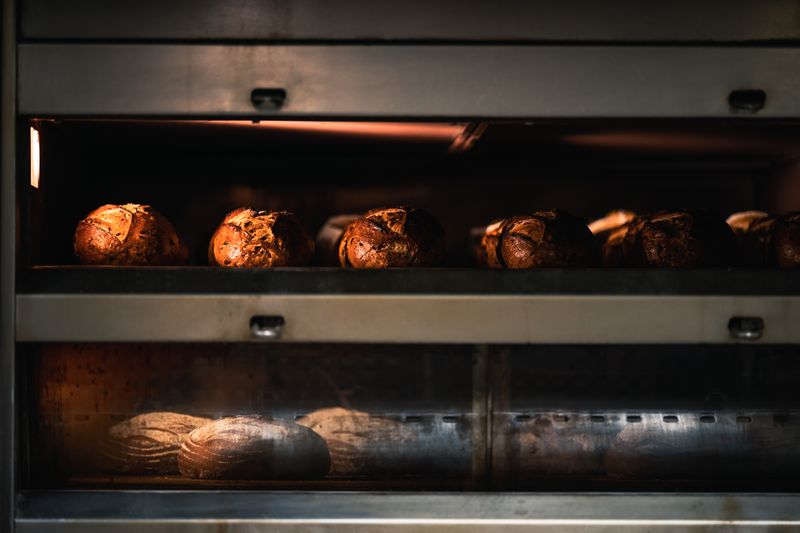
Most conventional ovens are hotter at the top, because heated air rises and the upper element is closer. Fan ovens even this out substantially, which is the main practical reason to use one for batch baking. Rotating trays partway through is standard practice in professional kitchens for exactly this reason.
Two trays on two shelves will not bake identically, whatever the oven claims.
Fan settings change the arithmetic
A fan moves air past the food, stripping away the insulating layer of still air and transferring heat faster. Recipes typically call for a reduction of around twenty degrees Celsius when converting to fan, though the right figure depends on the oven. The faster drying that comes with moving air suits roasting and biscuits and can be unkind to delicate cakes and custards.
Knowing which setting a recipe was written for is as important as the number itself.
Opening the door costs more than you think
A domestic oven loses a large part of its heat within seconds of the door opening, and takes minutes to recover. For anything relying on a rapid initial rise, such as souffles, choux or bread, that loss can be the difference between success and collapse. Using the internal light and the glass rather than the door is a small discipline with a real payoff.
For a long roast, by contrast, the effect is trivial and basting is not the crime it is sometimes made out to be.
Substitute freely; the method matters more than the shopping list.
Calibrate by baking, not by faith
Bake something familiar and note whether it browns early, late or unevenly, then adjust the dial rather than the recipe. Many ovens can be recalibrated in their settings, and some simply need to be treated as running hot or cool by a known amount. Keep the correction in mind as an offset rather than trying to remember it dish by dish.
Once you know your oven, most recipes that previously failed start working without any other change.
The takeaway
Buy a thermometer, learn your oven offset, and stop blaming the recipe.
Get the heat and the salt right and the rest is detail.
Questions readers ask
Do I need an oven thermometer?
If you bake at all, it is one of the cheapest useful things you can own. It tells you whether your oven is the problem before you blame the recipe.
Why does everything brown more on one side?
Uneven element placement or airflow, which is normal in domestic ovens. Rotating the tray halfway through is the standard fix.