Baking
Cooling is the last stage of baking, not the wait afterwards
Structures keep setting and moisture keeps moving long after the tin leaves the oven. Cutting early does not just release steam, it changes the texture permanently.
The points below about cooling baked goods are ordered by how much difference they make, not by how often they get repeated.
What matters most
- Starch continues to set as a bake cools, which is what firms the crumb.
- Trapped steam softens a crust from the inside if it cannot escape.
- Different bakes want different cooling arrangements.
The bake is not finished when the oven is
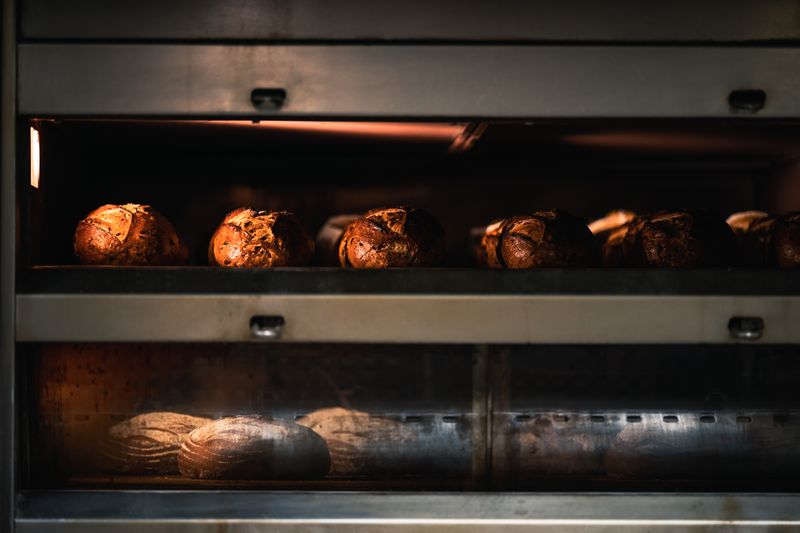
A cake or loaf leaving the oven is still extremely hot inside, and the chemical and physical changes that create structure are ongoing. Starch that gelatinised during baking continues to set as the temperature falls, which is what gives the crumb its final firmness. Cutting into it before that has happened produces a texture that reads as gummy or underbaked even when it is not.
The interior cannot be put back, so this is one of the few baking faults that is genuinely irreversible. Waiting is therefore a technique rather than a courtesy, and it is the one most often ignored.
Steam has to go somewhere
A hot bake contains a large amount of water as steam, and that steam moves outwards as the item cools. If it is trapped against a surface, it condenses there and softens whatever it touches.
In practice, that is why a loaf left in its tin develops damp sides and why a crisp crust goes soft under a cover. A wire rack lets air circulate underneath, which is the entire reason racks exist and why a plate is not equivalent. Removing an item from its tin at the right moment is a judgement between structural support and trapped moisture.
Different bakes, different treatment
A bread with a crisp crust wants to cool completely uncovered, in air, with nothing touching more of it than necessary. A soft-crusted loaf can be covered with a cloth as it cools, which deliberately traps some steam to keep the crust tender.
Delicate cakes often need a short rest in the tin so the structure firms enough to survive being moved. Rich or very moist bakes sometimes cool entirely in the tin, since removing them early risks collapse. The instruction in a recipe about how long to leave something in its tin is doing real work and should not be treated as filler.
Cooling and staling are related
Starch retrogradation, the process that makes bread stale, begins as soon as the bake starts to cool. It proceeds fastest at refrigerator temperatures, which is why bread stales more quickly in a fridge than on a worktop. This is also why a loaf tastes best on the day it was baked and noticeably different the next morning.
Freezing slows the process substantially, which makes a freezer the correct storage for bread you will not finish quickly. Reheating reverses some of the change temporarily, which is why toasting revives a stale slice.
Cutting too early and how to tell
The temptation to cut warm bread is understandable and the cost is a compressed, doughy interior along the cut. A loaf that is still warm in the centre will squash under the knife rather than slicing cleanly.
The part that matters: a serrated knife and a sawing motion reduce the damage, though they do not eliminate it. Feeling the base of the loaf gives a reasonable indication, since it stays warm longest. Where you genuinely cannot wait, cutting a smaller portion and leaving the rest intact limits the damage to one end.
If you are cooking for allergies, check every label rather than any recipe.
Storing after cooling
Anything stored while still warm generates condensation inside the container, which is the fastest route to a soft crust and to mould. Complete cooling before storage is therefore not optional, however long it takes. Bread stores best at room temperature in something that breathes slightly, rather than sealed in plastic.
At the stove, cakes are generally the opposite and keep better sealed, since drying out is their main enemy rather than sogginess. Knowing which of the two problems a given bake faces tells you immediately how it should be wrapped.
Everything above, in order of what to do first
- The bake is not finished when the oven is. A cake or loaf leaving the oven is still extremely hot inside, and the chemical and physical changes that create structure are ongoing.
- Steam has to go somewhere. A hot bake contains a large amount of water as steam, and that steam moves outwards as the item cools.
- Different bakes, different treatment. A bread with a crisp crust wants to cool completely uncovered, in air, with nothing touching more of it than necessary.
- Cooling and staling are related. Starch retrogradation, the process that makes bread stale, begins as soon as the bake starts to cool.
- Cutting too early and how to tell. The temptation to cut warm bread is understandable and the cost is a compressed, doughy interior along the cut.
- Storing after cooling. Anything stored while still warm generates condensation inside the container, which is the fastest route to a soft crust and to mould.
The takeaway
Get it out of the tin, onto a rack, and leave it alone until the base is no longer warm.
The good version is the one you can make on a Wednesday.
Questions readers ask
How long should I wait before cutting bread?
Until it is no longer warm in the centre. The starch is still setting as it cools, and cutting early leaves a compressed, gummy interior that cannot be fixed.
Why does my crust go soft after baking?
Trapped steam. Cool it on a rack with air underneath, out of its tin, and do not cover it or store it until it is completely cool.