Baking
How a crust actually forms, and why steam matters
The brown shell on a loaf is a sequence of events with a specific order. Interrupting it at the wrong moment is why crusts disappoint.
This works through bread crust in the order the parts actually depend on each other.
The short version
- Steam keeps the surface flexible so the loaf can expand.
- Browning cannot begin until the surface dries.
- Crust softens as it cools if moisture is trapped.
Two phases in one bake
A loaf needs a wet, flexible surface early so it can expand, and a dry surface later so it can brown. That is why steam goes into the oven at the start and comes out partway through. Getting the order wrong gives either a loaf that split awkwardly or one that is pale and soft.
Every covered-pot and tray-of-water method is an attempt to sequence these two phases at home.
Oven spring depends on flexibility
In the first minutes the gases in the dough expand and the yeast makes a final burst before dying from the heat. A surface that has already set cannot stretch, so the loaf bursts at a weak point instead of rising evenly. Steam condensing on the cool dough keeps that surface pliable for long enough to let the expansion happen.
Nine times out of ten, scoring the loaf gives the expansion a designated place to go, which is why the cuts open dramatically.
Then it has to dry
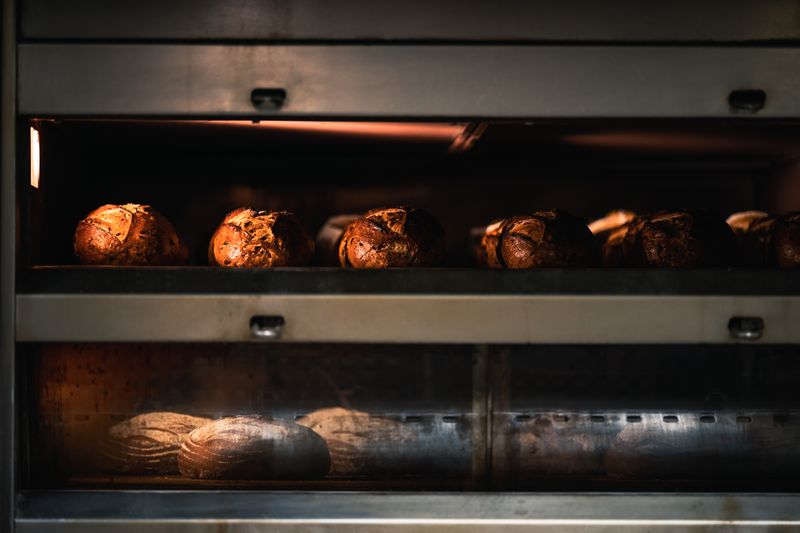
Browning reactions need the surface temperature to climb well above the boiling point of water, which cannot happen while it is wet. Removing the steam or the lid partway through lets the surface dry so colour and flavour can develop. Leaving the lid on for the whole bake gives a pale, leathery crust however long it stays in.
Nine times out of ten, the gelatinised starch on the surface is what gives the characteristic sheen when it dries under heat.
Producing steam at home
A covered pot traps the loafs own moisture and is the most reliable domestic method by a wide margin. A tray of boiling water or a preheated cast iron pan with water thrown in works in a leaky domestic oven, but less consistently. Spraying the loaf and the oven walls helps briefly, since domestic ovens vent steam quickly.
Whatever the method, the steam is only needed for roughly the first part of the bake.
Colour is flavour
A pale crust is not merely less attractive; it has developed far fewer of the aromatic compounds that make bread smell like bread. Taking a loaf out at the first hint of colour is one of the most common home baking hesitations. Sugar in an enriched dough browns faster, so those loaves need lower temperatures or covering partway.
At the stove, a dark crust with a bitter edge is a genuine overshoot, and there is a real window between the two.
If you are cooking for allergies, check every label rather than any recipe.
Cooling decides what you keep
A hot loaf continues to release steam, and if it sits on a solid surface that moisture collects and softens the base. Cooling on a rack lets air circulate and preserves the crust you just made. The crust of a lean loaf softens over hours anyway as moisture migrates outward from the crumb.
A few minutes in a hot oven the next day drives that moisture out again and restores the crust temporarily.
The takeaway
Steam first so it can rise, dry heat after so it can brown, and cool it on a rack.
Taste it before it leaves the pan. That is most of cooking.
Questions readers ask
Why is my crust soft the next day?
Moisture migrates from the crumb outward as the loaf sits. Reheating briefly in a hot oven drives it off and restores crispness for a while.
Do I need a cast iron pot?
It is the easiest way to trap steam, but any heavy lidded pot that survives the oven temperature does the same job. A large bowl inverted over the loaf on a tray also works.